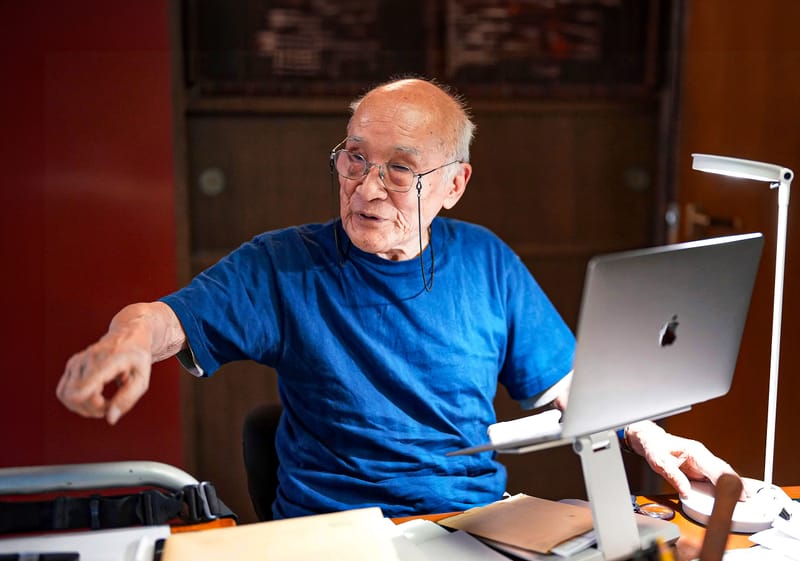
Popular Japanese Poet Shuntaro Tanikawa Dies at 92
8
Advanced
Vocabulary
Repeat each word, definition, and example sentence after your tutor.
pioneerVerbˌpaɪəˈniːr
to be the first to discover, do, develop, etc. something
The first Star Wars movie pioneered special effects techniques that changed the film industry.
stunVerbstʌn
to surprise or shock
The September 11 attacks in New York stunned the world and had far-reaching consequences.
debutNounˈdeɪbjuː
the first public appearance of someone or something
Lionel Messi made his debut for FC Barcelona in 2003.
vastnessNounˈvæstnəs
very great size, extent, etc.
The vastness of the universe is beyond human comprehension.
sproutVerbspraʊt
(of plants) to put out new, young branches
The beetroots are finally starting to sprout.
bearVerbber
to produce flowers or fruit
The apple trees have finally started to bear fruit this year.
Article
Read the article aloud on your own or repeat each paragraph after your tutor.Popular Japanese Poet Shuntaro Tanikawa Dies at 92Popular Japanese Poet Shuntaro Tanikawa Dies at 92
Shuntaro Tanikawa, who pioneered modern Japanese poetry, has died aged 92.
Tanikawa, who also translated the Peanuts comic strip and wrote the lyrics for the theme song of the animation series Astro Boy, died on November 13, his son Kensaku Tanikawa has said.
He said his father died at a Tokyo hospital due to old age. "His poems are with you forever," he added.
Shuntaro Tanikawa stunned the literary world with his 1952 debut Two Billion Light Years of Solitude, a work that contrasted the individual against the vastness of the universe.
Written before Gabriel García Márquez' One Hundred Years of Solitude it became a bestseller.
He said in an interview with The Associated Press in 2022: "For me, the Japanese language is the ground. Like a plant, I place my roots, drink in the nutrients of the Japanese language, sprouting leaves, flowers and bearing fruit."
Tanikawa explored poetry, not only in the repetitive music of the spoken word but also the magic hidden in little things.
In all of Tanikawa's work, a respectful love for the beauty of the Japanese language shines through.
His work has been translated into a number of different languages, while some of his works have been made into picture books for children and they're often featured in Japanese school textbooks.
Tanikawa was born in 1931, a son of philosopher Tetsuzo Tanikawa, and he began writing poetry in his teens.
He said he used to think poems descended like an inspiration from the heavens. But, as he grew older, he felt the poems coming up from the ground.
In person, Tanikawa was friendly, often reading in public with other poets. He never seemed to take himself too seriously but used to confess his one regret in life was never finishing his education, having dropped out at a young age after becoming well-known.
He is survived by his son, daughter and grandchildren.
Discussion
Have a discussion based on the following questions.- What are your thoughts on Shuntaro Tanikawa's passing?
- Have you read anything by Tanikawa? What did you make of it?
- Do you like reading poetry? Who are your favorite poets?
- Who are some of your country's most important literary figures?
- If you could only read one writer for the rest of your life, who would you pick?
Further Discussion
Have a discussion based on the following questions.- Have you ever done any creative writing?
- Did you read much when you were young? What kind of books were you into?
- How has your taste in books changed over the years?
- Are there any popular writers whose works you dislike?
- A poet is, before anything else, a person who is passionately in love with language. — W.H. Auden. What are your thoughts on this quote?