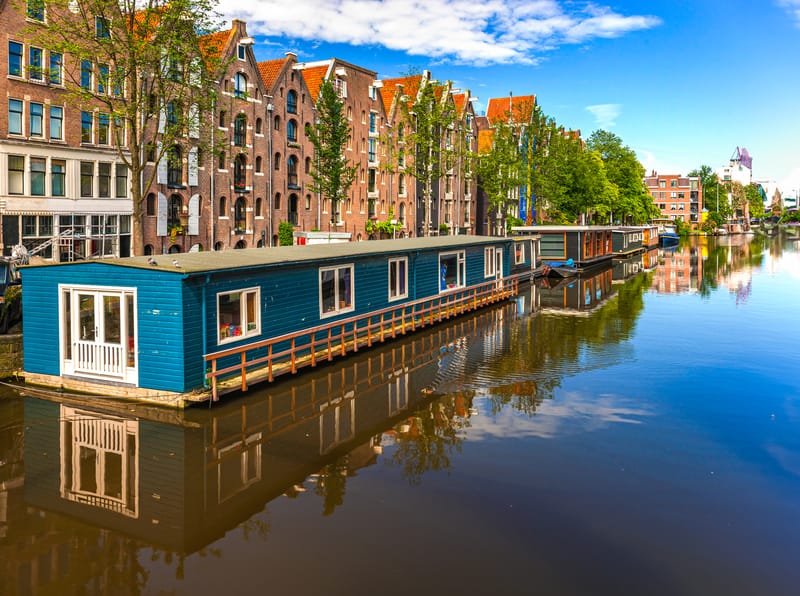
Floating Homes Offer Hope amid Rising Waters
8
Advanced
Vocabulary
Repeat each word, definition, and example sentence after your tutor.
submergeVerbsəbˈmɜːrdʒ
to cause to be under a liquid; to go down below the surface of a body of water
The cornfield was completely submerged by the flood.
embraceVerbɪmˈbreɪs
to accept or support a new idea, technology, belief, etc. with enthusiasm
Young people are usually quick to embrace new technology.
proneAdjectiveprəʊn
likely to experience, suffer from, etc. something unpleasant or negative
The Pacific Ring of Fire is an area particularly prone to volcanic eruptions.
stiltNounstɪlt
each of a set of posts that supports a building and raises it above the ground or water
Inle Lake is a village built on stilts in Myanmar. 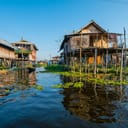
sewerNounˈsuːər
a large underground pipe that carries liquid waste away from houses, factories, etc.
There was so much rain that the sewers backed up along this street.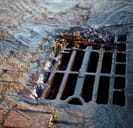
hullNounhʌl
the main body of a ship or submarine
The iceberg caused major damage to the hull, causing the ship to sink.
Article
Read the article aloud on your own or repeat each paragraph after your tutor.Floating Homes Offer Hope amid Rising WatersYou may have seen projections of how the world could look in the future if climate change continues to get worse.
These maps often show large parts of the world submerged underwater.
Perhaps things won't ever get as bad as that. Or perhaps we'll have to learn to live with — or even on — water.
In some places, they're already doing exactly that.
The Netherlands is one of those places. And there's a good reason for it — about one-third of the country is below sea level.
More and more Dutch people are embracing floating homes. They've already got the world's largest floating office building, as well as a floating farm.
Of course, living on water isn't new. People in flood-prone areas have been building their houses on stilts for ages. And then there are the many people around the world who live on boats.
But modern technology is helping to make floating houses more closely resemble the land homes people are used to.
According to the Yale School of the Environment, these houses often rest on steel poles and "are usually connected to the local sewer system and power grid."
It adds that they are "structurally similar to houses built on land," but have a heavy concrete "hull" underneath that helps them stay stable.
They rise when the water rises and fall when it falls.
They may not be for everyone. Some residents say the buildings don't just rise and fall — they rock. They're also a little more difficult to connect to power grids and sewers.
However, they do solve some problems for city planners. Cities are under pressure for space, and floating buildings allow communities to expand in a new way.
And it's not only the Netherlands that's embracing the idea. These types of homes are also being built in some of the island nations that are most at risk of sea-level rise caused by climate change.
This could be just one of the ways we adapt to a watery future — which might arrive sooner than we think.
Discussion
Have a discussion based on the following questions.- What are your thoughts on the Netherlands' floating homes?
- Would you consider living in a floating house?
- What parts of your country are most at risk from rising sea levels?
- How noticeable are the effects of climate change where you live?
- Are houses in your country designed to suit a particular climate or protect against certain weather events?
Further Discussion
Have a discussion based on the following questions.- Have you been to the Netherlands? Could you see yourself living there?
- What's a typical house like where you live?
- What would your dream home look like?
- How do you imagine your town or city will change over the next few decades?
- Do you think you'd enjoy working as an architect?